
Antibody-Specific Structure Tools vs. General-Purpose Models

If general-purpose models like AlphaFold2 can predict protein structures at near-experimental accuracy for many proteins, why do specialized, antibody-specific structural tools exist and receive active development?
The answer is not that general-purpose models fail on antibodies entirely. Rather, it is that antibody variable domains possess specific structural and evolutionary properties that systematically push general-purpose models toward their weakest performance regime. In a high-stakes clinical antibody engineering pipeline, relying solely on general-purpose algorithms introduces critical bottlenecks in conformational accuracy, design throughput, and sequence recovery.
This article serves as a definitive, technically precise reference guide to antibody design tools. We analyze the biophysical properties that make antibodies structurally unusual, examine the mechanisms behind ABodyBuilder2 and AntiFold antibody design specifically, and outline a practical decision framework for choosing the correct computational pipeline for your specific screening and design assays.
Selecting the Right Modality and Tool
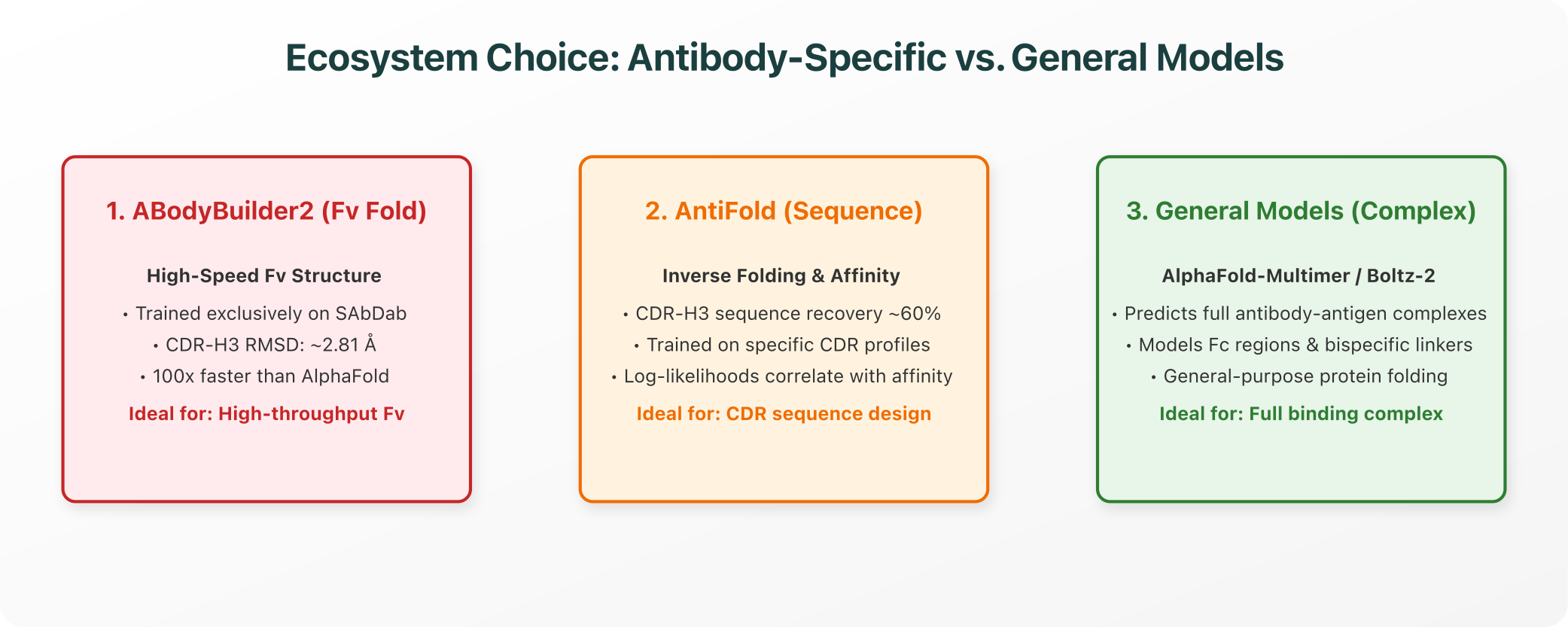
Different computational architectures are optimized for different computational scales, transitioning from fast single-domain Fv folding to full multi-component binding complexes:
1. Why Antibody Variable Domains Are Structurally Unusual
Monoclonal antibodies are highly specialized binding proteins, and their target specificity is driven almost entirely by six loops on the variable domain: the Complementarity-Determining Regions (CDRs). Among these, the heavy-chain CDR3 (CDR-H3) loop is the primary determinant of binding specificity and is structurally hypervariable.
- The Problem with MSAs: General-purpose structure prediction models (such as AlphaFold) rely heavily on the Multiple Sequence Alignment (MSA) to identify co-evolving residue pairs. If residue 45 in a protein mutated, and residue 90 consistently mutated in tandem to maintain a salt bridge, the model uses this co-evolutionary covariance to constrain and predict the 3D fold.
- The CDR-H3 Loop Exception: The CDR-H3 loop falls completely outside this co-evolutionary paradigm. Its extreme sequence diversity is generated through genomic V(D)J recombination and somatic hypermutation, meaning there is no stable evolutionary conservation across antibody lineages.
- The Downstream Consequence: Because there is no strong co-evolutionary signal in the MSA, general-purpose models must predict CDR-H3 conformation primarily from local physical priors, resulting in lower structural accuracy (higher Root Mean Square Deviation, or RMSD) specifically on these critical loops, even if the surrounding framework region is modeled perfectly.
2. ABodyBuilder2: High-Speed Antibody Folding
Developed by the Deane Lab at the University of Oxford, ABodyBuilder2 is an antibody-specific structure prediction model designed to address these conformational bottlenecks.
- Domain-Specific Training: Unlike AlphaFold, which is trained on the entire Protein Data Bank (PDB), ABodyBuilder2 is trained exclusively on solved antibody structures compiled in the Structural Antibody Database (SAbDab database).
- The Accuracy Advantage: On benchmark panels, ABodyBuilder2 predicts CDR-H3 loop conformations with a mean RMSD of approximately 2.81 Å, compared to AlphaFold-Multimer antibody predictions averaging 2.90 Å, demonstrating superior local conformational accuracy on the most challenging loops.
- The Throughput Advantage: Because it utilizes a specialized neural network architecture optimized for antibody framework geometries, ABodyBuilder2 is more than 100 times faster than AlphaFold-Multimer for Fv-only predictions, making it the practical choice for high-throughput sequence screening where hundreds of candidate clones must be folded post-phage display.
- What It Is Not: ABodyBuilder2 only covers the variable domain (Fv) of the antibody. It does not predict antibody-antigen complexes directly or model the constant Fc region.
3. AntiFold: Antibody-Specific Inverse Folding
Inverse folding (predicting a stable amino acid sequence for a fixed 3D backbone) is a core task in antibody humanization and affinity maturation. While general-purpose inverse folders (such as ESM-IF1 or ProteinMPNN) are highly effective, they underperform on CDR loops because they were not trained on the unusual, hypervariable amino acid distributions found in antibody interfaces.
- The Stated Performance: AntiFold is an antibody-specific inverse folding tool fine-tuned from the general-purpose ESM-IF1 model using structural templates from SAbDab.
- The Sequence Recovery Advantage: In published benchmarks, AntiFold achieves a native sequence recovery rate of approximately 60% on CDR-H3 loops, compared to ESM-IF1's ~43%, showing a vastly superior capability to propose structurally compatible sequences that mimic natural antibody diversity.
- Affinity Correlation: Crucially, AntiFold's per-position log-likelihood scores correlate directly with experimental binding affinity zero-shot, allowing researchers to use the model's scores as a rapid, computational proxy for binding affinity during candidate screening.
4. Where General-Purpose Models Still Win
Despite the efficiency of antibody-specific tools, general-purpose models (such as AlphaFold-Multimer or Boltz-2) remain essential in several key phases of the pipeline:
- Antibody-Antigen Complexes: Specialized tools like ABodyBuilder2 do not model the antigen. If you need to predict the complete binding interface or identify specific contacting residues between the antibody and its target antigen, general-purpose multi-component models are required.
- Constructs Outside the Fv Domain: For modeling bispecific constructs, linker regions, fusion proteins, or the constant Fc region, general-purpose models are the appropriate choice.
5. A Practical Decision Framework
To optimize your computational antibody engineering pipelines, choose your tool based on the specific phase of design:
- Use ABodyBuilder2 When: You need fast, high-throughput structural profiling of Fv regions across a large library of sequence hits (e.g., triage of hundreds of clones post-sequencing), or when local CDR-H3 loop accuracy is the primary priority in a cell-free analysis.
- Use AntiFold When: You are humanizing an antibody, redesigning CDR sequences for a fixed framework, or need a rapid, computational affinity-correlated score to prioritize candidate sequences for wet-lab synthesis.
- Use AlphaFold-Multimer or Boltz-2 When: You need to model the full antibody-antigen complex, predict contact interfaces, or analyze complex constructs outside the variable domain (such as bispecifics or Fc fusion proteins).
References and Authoritative Specifications
For antibody engineers seeking to review the structural biology datasets and algorithmic specifications discussed, the following publications serve as primary references:
- The ABodyBuilder2 Publication: Abanades, B. et al. (2023). "ABodyBuilder2: improved antibody structure prediction using deep learning." Bioinformatics, 39(4), btad123. doi:10.1093/bioinformatics/btad123
- The AntiFold Publication: Høie, M. H. et al. (2024). "AntiFold: improved antibody inverse folding using deep learning." Bioinformatics Advances, 4(1), vbae021. doi:10.1093/bioinformatics/vbae021
- The SAbDab Database: Dunbar, J. et al. (2014). "SAbDab: the structural antibody database." Nucleic Acids Research, 42(D1), D1140-D1146. doi:10.1093/nar/gkt1043
- AlphaFold-Multimer Antibody Benchmarks: Evans, R. et al. (2021). "Protein complex prediction with AlphaFold-Multimer." bioRxiv. doi:10.1101/2021.10.04.463034
Explore Purna's Molecular Intelligence Platform
AI-powered workspace for biology teams to accelerate drug discovery from target identification to lead optimization.
Try Purna AI →