
MHC Class I vs Class II: Why Epitope Prediction Tools Need to Know the Difference

A common, practical failure mode in computational immunology is the selection of incorrect parameters in T cell epitope prediction tools. When designing a vaccine immunogen or mapping cancer neoantigens, researchers occasionally treat Major Histocompatibility Complex (MHC) Class I and Class II as minor, interchangeable formatting variables on a dropdown menu.
This is a fundamental biological error. Stating that MHC I and MHC II are different is not a trivial technical detail: it is a deep, structural and functional divergence that dictates how an epitope prediction tools platform must operate under the hood. A model trained to solve for MHC I binding cannot mathematically or biochemically generalize to MHC II targets. Attempting to cross-apply these tools or ignoring their different training constraints produces outputs that look highly plausible in your spreadsheets but are completely meaningless in the wet-lab.
This article serves as a definitive, technically precise reference guide to MHC Class I vs Class II prediction. We analyze their biophysical differences, explore why Class II prediction is a fundamentally harder computational problem, and explain how these biological realities dictate HLA allele selection and tool design.
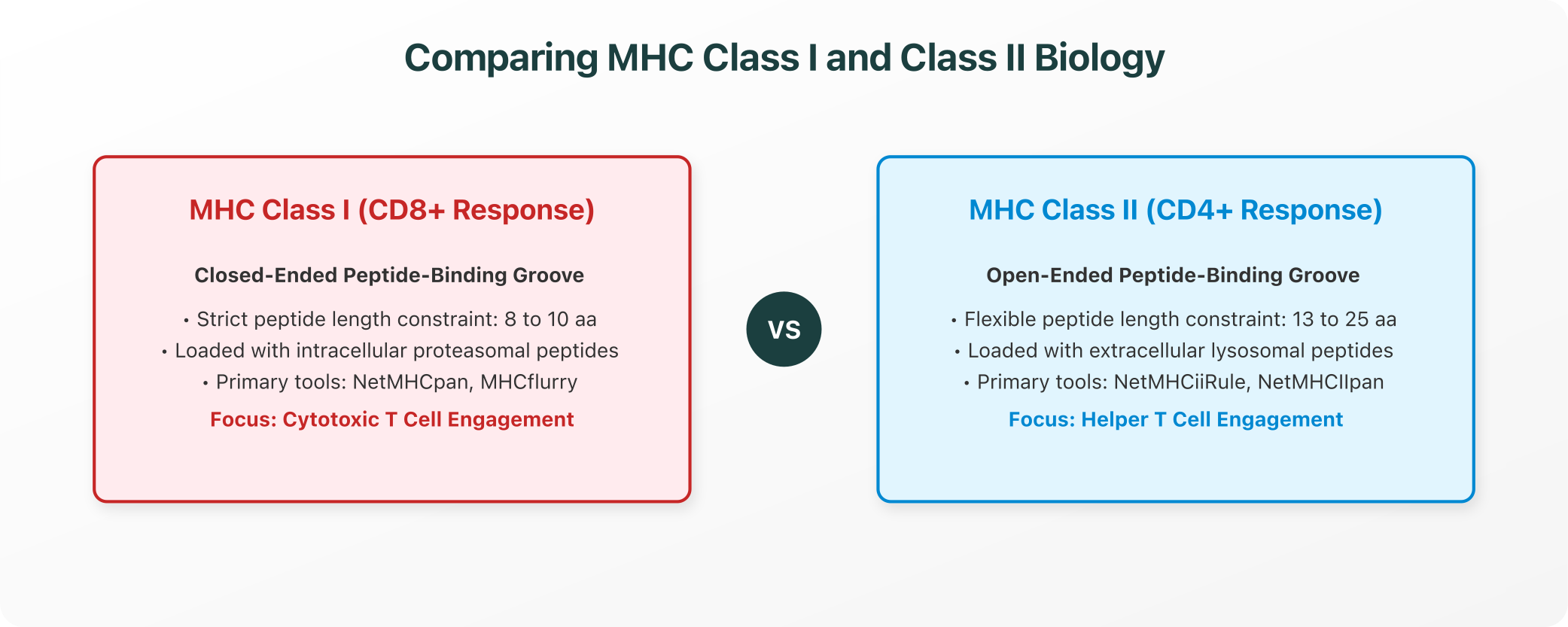
Comparing MHC Class I and Class II Biology
The underlying cellular pathways and structural architectures of the two MHC classes dictate their peptide length constraints and modeling algorithms:
1. The Structural and Functional Divergence
The biological purpose of the MHC system is to present short peptide fragments on the cell surface for inspection by T cells. However, the origin, length, and functional destinations of these peptides are strictly segregated:
- MHC Class I (The Intracellular Pathway):
- Expression: Present on virtually all nucleated cells in the body.
- Peptide Source: Loaded with short, 8 to 10 amino acid peptides derived from intracellular proteins degraded by the proteasome.
- T Cell Engagement: Presents targets to CD8+ cytotoxic T cells, driving the direct clearance of virally infected or cancerous cells.
- The Peptide-Binding Groove: Crucially, the peptide-binding groove of MHC Class I has physically closed ends. This imposes a strict, rigid length constraint on the peptide. The pocket acts as a tight molecular cradle, forcing the peptide backbone to bulge upward if it exceeds 9 residues, but restricting overall length to a highly uniform range.
- MHC Class II (The Extracellular Pathway):
- Expression: Restricted exclusively to "professional" antigen-presenting cells (APCs) such as dendritic cells, macrophages, and B cells.
- Peptide Source: Loaded with longer, 13 to 25 amino acid peptides derived from extracellular proteins engulfed by the cell and processed via lysosomal cathepsins.
- T Cell Engagement: Presents targets to CD4+ helper T cells, driving overall immune coordination, B cell antibody class-switching, and cytokine signaling.
- The Peptide-Binding Groove: Unlike Class I, the peptide-binding groove of MHC Class II has physically open ends. This allows the peptide to extend out of the groove on both sides, much like a hot dog in a bun. Binding is anchored by a core 9 amino acid sequence (the binding core) that sits directly in the pocket, while the flanking residues extend freely outside.
2. Why Class II Prediction is a Harder Computational Problem
The open-ended structure of the MHC Class II groove makes computational modeling and algorithm design fundamentally harder than for Class I:
- The Sliding Core Inference Problem: For an MHC Class I prediction tool (like NetMHCpan or MHCflurry), the input peptide is typically 9 amino acids long, matching the closed groove size exactly. For MHC Class II prediction, the input peptide is much longer (e.g., 15 to 20 residues). To calculate binding affinity, the tool (such as NetMHCpan NetMHCIIpan) must first solve a complex hidden-variable problem: identifying exactly which 9 amino acid window within that 20-residue sequence serves as the binding core, and then calculating how the flanking residues modify that binding energy.
- Structural Diversity of MHC II Heterodimers: MHC Class I proteins consist of a highly variable alpha chain paired with a constant beta-2 microglobulin backbone. MHC Class II molecules, however, are heterodimers consisting of two separate, highly variable chains (alpha and beta). The allelic combinations of these two chains (particularly in HLA-DP and HLA-DQ) create a much larger space of structural conformations than observed in HLA-A, -B, or -C, requiring vastly more training data to capture the full scope of binding specificity.
- Heterogeneous Training Data: Because of these length and structural complexities, high-throughput MHC Class II binding assays are historically more heterogeneous, lower-yield, and harder to standardize than Class I assays, leaving developers with sparser, noisier training datasets.
3. Allelic Diversity and the Supertypes Concept
The Human Leukocyte Antigen (HLA) region is the most polymorphic segment of the human genome. Thousands of distinct classical HLA alleles exist across human populations.
To make prediction manageable, computational immunologists group alleles with similar binding pocket shapes and peptide preferences into "supertypes."
- Class I Supertypes: Highly established and reliable. Alleles within the HLA-A2 or HLA-A3 supertypes share consistent pocket characteristics, allowing a prediction tool to generalize binding rules across related alleles with high accuracy.
- Class II Supertypes: Far more difficult to define. Because of the open-ended groove and the variable residues flanking the binding core, alleles within a Class II family (such as HLA-DR) exhibit far more overlapping, promiscuous binding profiles, making strict supertype classification less reliable for predicting clinical responses.
4. Practical Consequences: Designing the Wrong Immunogen
Failing to distinguish between these two pathways has severe, real-world consequences in vaccine and cancer immunotherapy design:
- Targeting the Wrong Arm: If a research team designs a synthetic cancer vaccine intending to drive a robust, tumor-clearing CD8+ cytotoxic T cell response, they must utilize Class I prediction algorithms. If they accidentally use Class II algorithms or fail to specify the strict 9-residue limit, the resulting peptide constructs will be too long, loaded via the lysosomal pathway, and presented primarily to CD4+ helper T cells. While helper T cells are essential, they cannot directly lyse tumor cells, potentially rendering the vaccine therapeutically ineffective.
- Model Selection Matters: For high-confidence epitope mapping, researchers should use standard tools built specifically for the target pathway: NetMHCpan (or MHCflurry) for Class I CD8+ epitopes, and NetMHCIIpan for Class II CD4+ helper epitopes. Stating which class and which prediction algorithm version were utilized is as fundamental to reporting an epitope prediction as stating which HLA allele the run was mapped against.
Closing: Selecting by Intended Mechanism
Epitope prediction is not a generic "one-size-fits-all" computational task. The correct computational pipeline is dictated first by which branch of the adaptive immune response your therapy is designed to engage:
- MHC Class I is the necessary choice for intracellular target presentation and cytotoxic CD8+ T cell clearance.
- MHC Class II is the essential choice for extracellular target presentation and helper CD4+ T cell coordination.
By grounding your HLA allele selection and model choices in these rigid structural and cellular realities, immunology and vaccine design teams can ensure their in silico pipelines produce highly selective, biologically active epitope candidates that validate reliably in the clinic.
References and Authoritative Specifications
For computational immunologists seeking to review the primary literature and software documentations discussed, the following publications serve as primary references:
- NetMHCpan and NetMHCIIpan specifications: Reynisson, B. et al. (2020). "NetMHCpan-4.1 and NetMHCIIpan-4.0: improved predictions of MHC antigen presentation by integrating binding affinity and mass spectrometry ELIGIDs." Nucleic Acids Research, 48(W1), W449-W454. doi:10.1093/nar/gkaa379
- MHC Structural Biology and Peptide Presentation: Neefjes, J. et al. (2011). "Towards a systems understanding of MHC class I and MHC class II antigen presentation." Nature Reviews Immunology, 11(12), 823-836. doi:10.1038/nri3084
- MHCflurry Deep Learning Predictor: O'Donnell, T. J. et al. (2018). "MHCflurry: Open-Source Class I MHC Binding Affinity Prediction." Cell Systems, 7(1), 129-132. doi:10.1016/j.cels.2018.05.014
- HLA Allelic Polymorphism and Supertypes: Sette, A., & Sidney, J. (1999). "Nine HLA class I supertypes, as defined by shared peptide binding patterns, describe a practical majority of HLA-A and HLA-B polymorphism." Immunogenetics, 50(3-4), 201-212. doi:10.1007/s002510050594
Explore Purna's Molecular Intelligence Platform
AI-powered workspace for biology teams to accelerate drug discovery from target identification to lead optimization.
Try Purna AI →