
RFdiffusion vs. BoltzGen: Unifying Backbone and Sequence in De Novo Binder Design

The field of de novo protein binder design is undergoing a major, quiet transition. For several years, the standard paradigm for creating a binder molecule against a therapeutic target has relied on a decoupled, two-model pipeline: first generating a three-dimensional backbone shape, and then separately solving for an amino acid sequence that will fold into that shape.
While highly successful and validated, this two-step decoupling introduces significant biophysical limitations. Because the backbone generator is blind to the chemical details of individual side chains during coordinates generation, it frequently produces geometric folds that are thermodynamically unstable or impossible to design with natural amino acids. Recent advances have challenged this paradigm, introducing unified models that solve for structure and sequence simultaneously.
This article serves as a definitive, technically precise comparative guide, analyzing the biophysical differences between the decoupled RFdiffusion pipeline and the newly introduced, unified BoltzGen architecture, and outlines what this methodological divergence means practically for computational biology teams.
The Core Architectural Shift
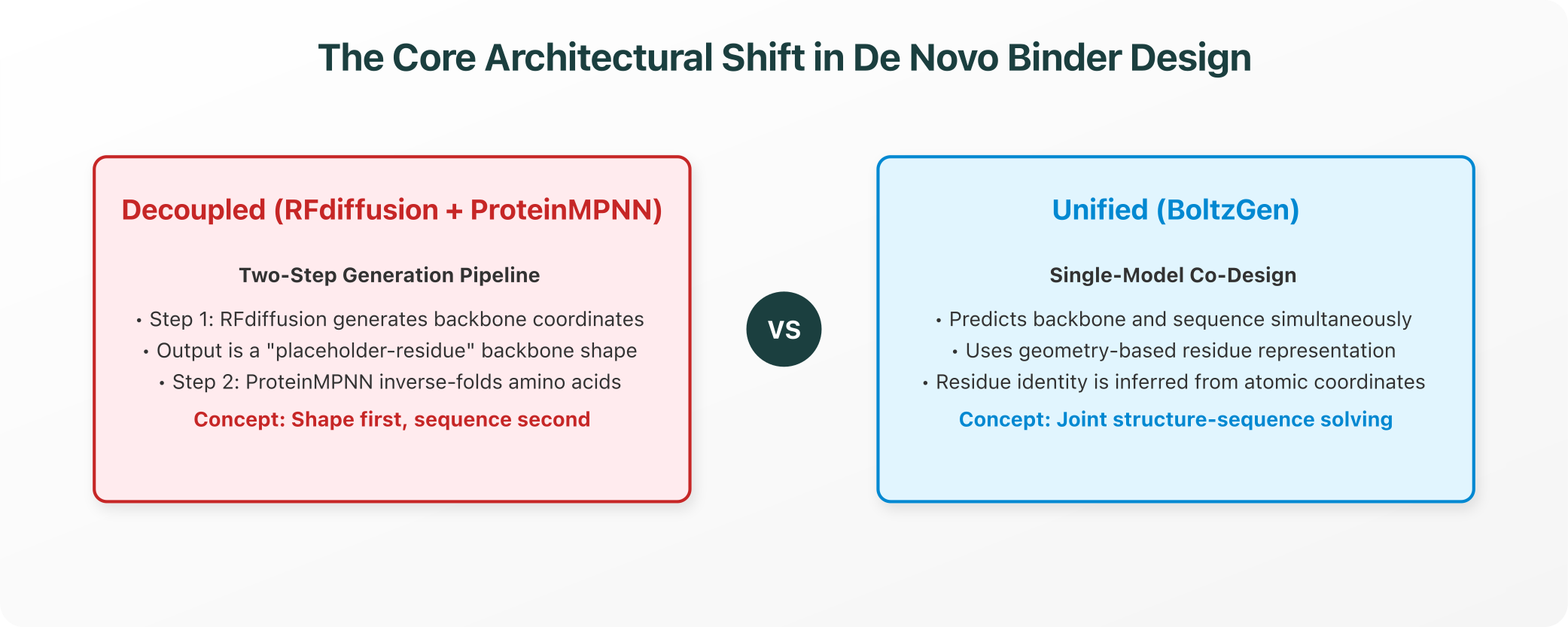
The transition from decoupled pipeline components to a single-model co-design architecture is a major shift in how macromolecular binding interfaces are solved:
1. The Decoupled Paradigm: RFdiffusion and ProteinMPNN
The decoupled approach, developed primarily by the Baker Lab at the University of Washington, represents binder design as a sequential two-model problem.
- Backbone Generation (RFdiffusion): RFdiffusion is a deep-learning diffusion model designed specifically to generate protein backbone coordinates. It is conditioned on a target structure and specified "hotspot" residues.
- The Output: It outputs a 3D coordinate model of the binder backbone. Crucially, this backbone contains no side chains or sequence identity; it is represented entirely by placeholder residues (typically poly-alanine or poly-glycine).
- Sequence Design (ProteinMPNN): To assign amino acids to this generated shape, the researcher must pass the backbone coordinates into a separate ProteinMPNN inverse folding model. ProteinMPNN utilizes a message-passing neural network to calculate the most probable, stable amino acid sequence that will physically fold into the generated backbone coordinates.
- Why It Became the Standard: This two-model pipeline has been extensively validated across dozens of published drug discovery campaigns. By breaking the problem into discrete steps, it allows researchers to generate thousands of diverse backbones in parallel, filtering out poor geometries before running the computationally intensive sequence design phase.
2. The Unified Paradigm: BoltzGen and Boltz-2
Announced in late 2025, BoltzGen introduces a unified, single-model approach built directly on the Boltz-2 protein design and structure prediction architecture.
- Simultaneous Design and Prediction: Unlike the decoupled pipeline, BoltzGen does not generate a sequence-blind backbone first. Instead, it solves for both the three-dimensional atomic coordinates and the amino acid sequence identity simultaneously in a single model run.
- Geometry-Based Residue Representation: BoltzGen achieves this by utilizing a purely geometry-based residue representation. In this framework, the model does not treat residue identity as a discrete textual label. Instead, the identity of an amino acid is mathematically inferred from the precise physical geometry of its atomic coordinates in continuous 3D space.
- The Architectural Advantage: Because the design and folding processes occur simultaneously within the same network layers, the model is fully aware of side-chain biophysical constraints and steric clashes while it is optimizing the backbone conformation. This eliminates the risk of generating "undesignable" backbones, producing binders with higher predicted thermodynamic stability and interface alignment directly from the model.
3. Validation and Track Record
When selecting between these architectures, researchers must weigh established track records against emerging capabilities:
- RFdiffusion Validation: RFdiffusion possesses a multi-year, peer-reviewed track record of successful wet-lab validation campaigns. It has successfully generated nanomolar-affinity binders against diverse, high-value therapeutic targets, including cytokines, viral receptors, and G-protein coupled receptors (GPCRs).
- BoltzGen Validation: As documented in its recent bioRxiv preprint ("BoltzGen: Toward Universal Binder Design", November 2025), BoltzGen’s validation has focused on achieving broader modal versatility. The Boltz team demonstrated successful wet-lab binder designs across:
- Diverse Binder Modalities: Including nanobodies, helical bundles, and disulfide-bonded cyclic peptides.
- Diverse Target Types: Successfully designing binders against not just proteins, but also intrinsically disordered regions, nucleic acids, and small-molecule ligands.
- Target Specificity: Demonstrating robust binding on target interfaces that have exceptionally low sequence identity to anything in the PDB's bound-structure set, proving the model is capable of genuine de novo generalization rather than simple template-copying.
4. Practical Differences and Specification Control
The user experience and programming syntax of the two tools reflect their different design philosophies:
- Conditioning and Input Syntax:
- RFdiffusion relies on a strict contig-based conditioning syntax. The user defines which segments of the target to keep fixed and specifies "hotspots" (coordinates where the binder must make contact) in a command-line configuration file.
- BoltzGen introduces a unified design specification language. It allows researchers to define more fine-grained structural constraints directly in the input file, such as specifying covalent bonds, local secondary structures, and precise active-site coordinates across multiple polymer types.
- Target General-Purpose Capability:
- RFdiffusion is primarily optimized for protein-protein target engagement. Designing binders for non-protein targets (like small molecules or nucleic acids) requires complex workarounds or separate specialized tools (such as RFdiffusion_allflow).
- BoltzGen is inherently multi-component, designed from the ground up to handle small molecules, DNA, RNA, and proteins natively in a single coordinate system.
Closing: Selecting the Right Modality for Your Workspace
The decision between RFdiffusion and BoltzGen is not about choosing which model is definitively superior, but about aligning your computational resources with your project constraints:
- Select the RFdiffusion + ProteinMPNN Pipeline if your lab has an established, highly optimized high-throughput pipeline already validated for protein-protein binder design, and you prefer to rely on a model class with a multi-year, peer-reviewed track record.
- Select the BoltzGen Architecture if you are targeting non-protein ligands (such as small molecules or nucleic acids), require complex structural constraints (like disulfide bonds or covalent linkages), or want to leverage a single-model interface that co-designs structure and sequence simultaneously.
By understanding these structural and biophysical differences, computational biology teams can choose the tool class best suited to their target, ensuring their design campaigns produce highly stable, validated binders with maximum efficiency.
References and Authoritative Specifications
For protein engineers seeking to inspect the underlying statistical architectures and validation datasets discussed, the following publications serve as primary references:
- The RFdiffusion Publication: Watson, J. L. et al. (2023). "De novo design of protein interactions with RFdiffusion." Nature, 620(7975), 1089-1100. doi:10.1038/s41586-023-06415-8
- The ProteinMPNN Publication: Dauparas, J. et al. (2022). "Robust deep learning-based protein sequence design using ProteinMPNN." Science, 378(6611), 49-56. doi:10.1126/science.add1964
- The BoltzGen Preprint: "BoltzGen: Toward Universal Binder Design." bioRxiv, November 2025. biorxiv.org
- The Boltz-2 Open-Source Specification: "Boltz-2: High-accuracy structure prediction and design." Boltz Project Documentation. github.com/boltz-project
Explore Purna's Molecular Intelligence Platform
AI-powered workspace for biology teams to accelerate drug discovery from target identification to lead optimization.
Try Purna AI →